The Department of Anatomy at Sahara Medical College serves as the foundational pillar of medical education, introducing aspiring doctors to the intricate architecture of the human body. Designed to bridge the gap between basic science and clinical application, the department offers a learning environment equipped with state-of-the-art facilities, including modern prosecution suites, advanced CADAVIS systems and a histology laboratory. Through an integrated curriculum that weaves together Gross Anatomy, Embryology, Histology, and Neuroanatomy, students develop a deep spatial and functional understanding of human structure. Supported by a distinguished faculty dedicated to mentorship and academic rigor, the department fosters critical clinical reasoning from day one, laying an unwavering groundwork for future surgical, diagnostic, and clinical excellence.
- Dissection Hall & Cold Storage:
An air-conditioned Dissection Hall accommodating up to 70 students simultaneously, equipped with stainless steel dissection tables, shadowless surgical lighting, embalming plants, and mortuary cabinets holding up to 8 cadavers. - Anatomy Museum:
Extends over 1,500 sq. ft., housing over 200 mounted specimens, embryological developmental models, cross-sectional anatomy displays, and full-body human skeletons. - Histology Laboratory & Digital Imaging:
Features high-grade binocular optical microscopes, slide preparation units, a microtome setup, and integrated CADAVIS tools. - Small Group Teaching:
Dedicated demonstration rooms with a minimum seating capacity of 35 students each, outfitted with smart interactive boards and multimedia projectors. - Skills Laboratory:
It provides a controlled, state-of-the-art simulation environment where medical students bridge the gap between theoretical knowledge and clinical execution. Outfitted with high-fidelity task trainers, airway manikins, vascular access models, and surgical simulation stations, the facility allows learners to master essential procedural skills—ranging from basic venipuncture and catheterization to advanced resuscitation algorithms—prior to patient contact. - Bone Club:
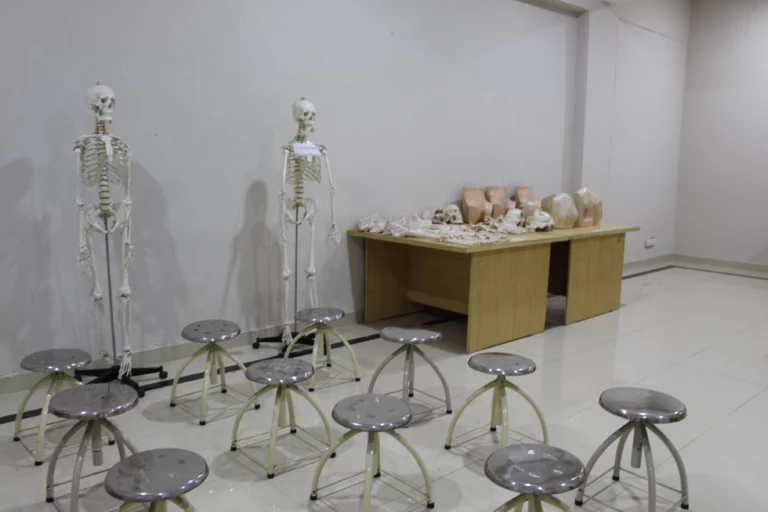
It serves as an interactive, peer-led academic forum designed to deepen students’ mastery of osteology, musculoskeletal anatomy, and orthopaedic correlates. Through regular small-group discussions, hands-on study of human skeletal remains, and clinical case reviews, members examine bone architecture, fracture patterns, surface land-marking, and surgical approaches.